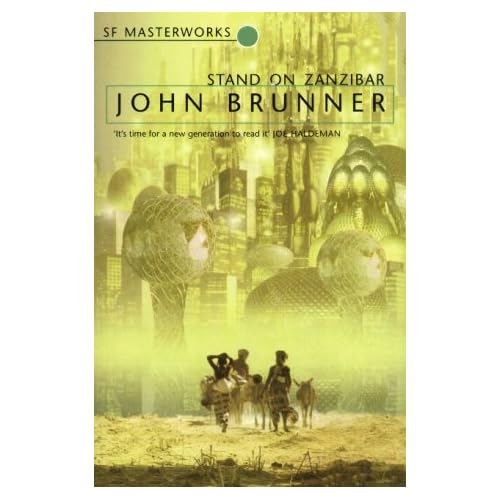
I enjoyed the thought work that John Brunner has developed in this story. He’s certainly made waiting for the bus extremely enjoyable. The book was written in 1968 and reads like a documentary about what the 2000s could have been like if you combine 1960’s social culture with the 1980-2000 megacorporations, and the US’s foreign policy of aggression.
I’ll talk more about the story in a later post, or scroll down to the references below and read the Wikipedia summary. I’m going to zero in on a powerful vignette which appears in book about war and economy.
The following excerpts from Stand on Zanzibar (context(11)– Come outside and Say That) gives everyone the ammunition to shoot down the NeoCon or aggressive foreign policy talk you may hear from our more war “compatible” citizens (excerpts from Zanzibar are indented).
War, like the weather just happens (no rational reason to wage it) (The “[-]” are cuts I made for brevity):
“So you believe that it’s in the interests of your family, friends and compatriots when you doll yourself up in uniform, take the gun you’re issued and go off to a messy death in the swamps of some place[-]”
“What Richardson demonstrated in essence[–]was that war follows a stochastic distribution: that’s to say, it’s neither absolutely random, nor yet is it definable in a systematic pattern, but something between the two. The pattern is there, but we cannot attribute one-for-one a causal relationship that would account for every specific cause.”
“In other words, the incidence of war is independent of the volitional element. It makes no odds whatever whether a rational decisions has been taken–war, like the weather, just happens.”
The Richardson, cited by the book is Lewis Fry Richardson, a pioneer in weather forecasting. Unfortunately, one might reason that because a war could break out at any time means you should have a powerful defense. What about the economic benefits of war? Brunner has more to say on this:
“Much earlier than Richardson, before World War I, in fact, Norman Angell had shown that the idea of fighting a war for profit was obsolete. The victors would pay a heavier cost than the losers. He was right, and that First World War proved the fact. The second one hammered it home with everything up to and including nuclear weapons. In an individual one would regard it as evidence of insanity to see someone repeatedly undertaking enterprises that resulted in his losing precisely what he claimed he was trying to achieve[-]”
Remember all that chatter about how the Iraq war would PAY FOR ITSELF? More people should read Norman Angell. I suspect Brunner felt the same which is why he felt it important to bring Norman’s work and Richardson’s Statistics of Deadly Quarrels into his story. 
I found Stand on Zanzibar an easier read than The Sheep Look Up due to their being more character continuity (the reader gets a lot of “face time” with Donald and Norman). Zanzibar is filled with interesting thought regarding society, population, and war. You’ll learn a lot on these topics while enjoying a great story. It isn’t often that I’m at a bus stop, reading through the book and then looking around at the city around me, completely amazed by the new outlook I’m getting. Failing all of that, the next time you go to a cocktail party, bring along a copy of “Statistics of Deadly Quarrels.” If your neocon sympathetic friends start talking about the glories of a good war economy, pull it out of your jacket (I hope you have a large one) and start talking while waving the book around.
They are sure to just agree rather than touch a book with the word “statistics” on its jacket.
References:
For more on Stand on Zanzibar, visit Wikipedia.
Here are some references related to the above excerpts. At the time of this posting, I wasn’t able to confirm that Richardson suggested that the decision on whether or not a nation goes to war is a random occurrence (please comment if you can add to this discussion). Though I feel that the wars in Vietnam, and Iraq support this:
- Introduction to War Cycles with interesting conclusions about Confucianism vs Western society:
http://en.wikipedia.org/wiki/War_cycles
- Lewis Fry Richardson: http://en.wikipedia.org/wiki/Lewis_Fry_Richardson
- Norman Angell http://en.wikipedia.org/wiki/Norman_Angell
- Norman Angell’s 1910 book on the economics of warfare: http://en.wikipedia.org/wiki/The_Great_Illusion